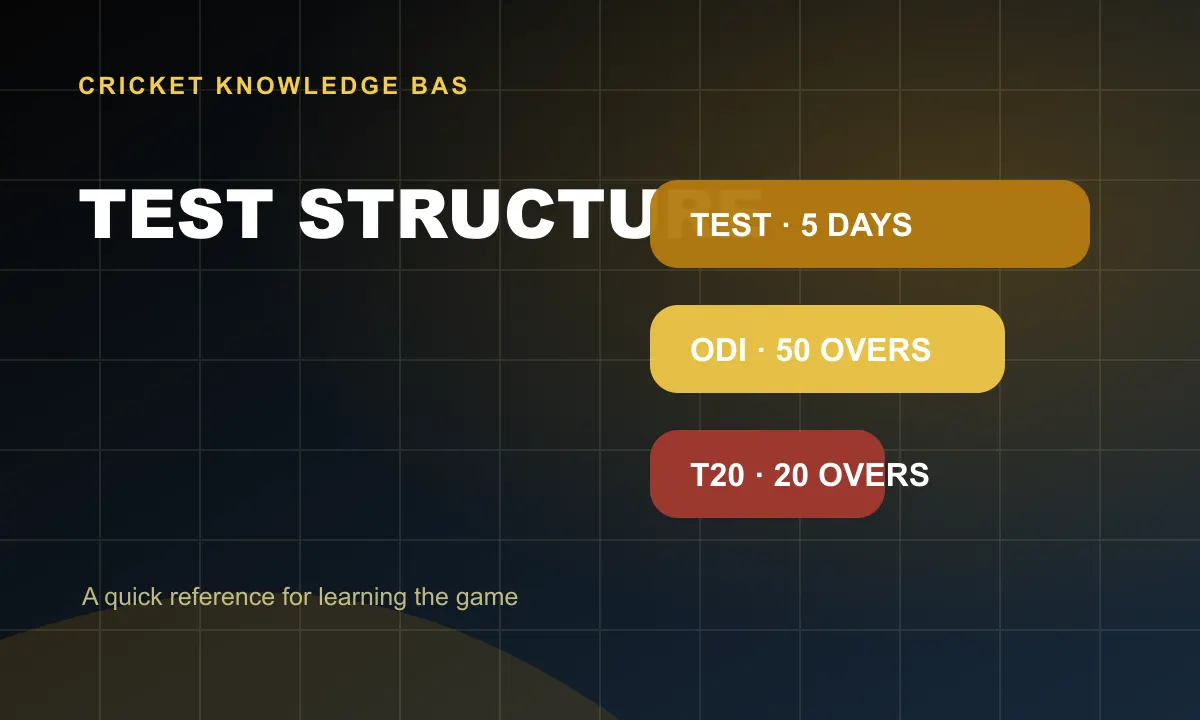
Test cricket is the longest international format and has been played since 1877. A match is now normally scheduled for up to five days, with each team entitled to two innings. Its defining challenge is not only scoring more runs but also creating enough time and wickets to complete a result.
Quick reference
| Length | Up to five days |
|---|---|
| Innings | Normally two per side |
| Fixed innings over limit | None |
| Possible results | Win, loss, tie or draw |
| Traditional clothing | White or cream |
| Key strategic tools | Declaration and follow-on |
How a Test match is structured
Teams alternate innings, though the follow-on can alter the usual order. An innings ends when ten wickets fall, a captain declares, a target is reached, a forfeiture occurs or play reaches its final limit. Days are divided into sessions with scheduled intervals.
Because innings do not have a standard over cap, teams balance run scoring with time. A slow but secure partnership can save a match; rapid scoring can create the hours needed for bowlers to pursue a win.
Declarations and the follow-on
A captain may declare an innings closed when satisfied with the score or when time becomes more valuable than additional runs. This voluntary decision lets the side begin bowling sooner but risks leaving a target the opponent can chase.
The follow-on permits a team with a substantial first-innings lead to ask the opposition to bat again immediately, subject to the law and match length. Captains consider pitch wear, bowler fatigue, weather and the danger of batting last.
Why the ball and pitch change the game
A new red ball may swing and seam, then soften as overs pass. Later, reverse swing or spin can become important. The pitch also wears over five days, creating cracks, rough areas and variable bounce that can make fourth-innings batting difficult.
Test technique therefore includes leaving dangerous balls, defending for long periods and attacking selectively. Bowlers build dismissals through repeated lines and fields rather than expecting every ball to take a wicket.
Wins, draws and tactical tension
A draw occurs when the scheduled time ends without a completed winning result. It is not the same as a tie, where scores finish level under the required completed conditions. A team can dominate much of a Test yet fail to take the final wickets before time expires.
That possibility creates tension unique to the format. The last hour can involve a chase, a battle for survival, or a fielding side surrounding the bat in search of one decisive chance.
How to learn this topic faster
Compare formats by resources rather than by stereotypes. Count balls, wickets, innings and available time, then ask how quickly those resources must be converted into runs. A choice that appears defensive in one format may be an intelligent response to conditions; a choice that looks exciting may leave too many unused risks later.
For What Is Test Cricket?, connect how a test match is structured with declarations and the follow-on. The first idea gives you the structure; the second shows how players or institutions act inside it. Then return to the quick-reference facts and explain each one in your own words. If a fact cannot yet be explained, follow the linked guide rather than memorizing the label.
A useful learning routine is to predict the next event before it happens. In a rules article, predict the umpire’s sequence. In a format article, predict how the batting side will spend its remaining balls. In history, predict which institution or technology made the next stage possible. Prediction turns passive reading into a test of understanding.
Key checkpoints
- Length: Up to five days. Use this as a checkpoint when reading a scorecard, watching a match or explaining the topic to someone else.
- Innings: Normally two per side. Use this as a checkpoint when reading a scorecard, watching a match or explaining the topic to someone else.
- Fixed innings over limit: None. Use this as a checkpoint when reading a scorecard, watching a match or explaining the topic to someone else.
- Possible results: Win, loss, tie or draw. Use this as a checkpoint when reading a scorecard, watching a match or explaining the topic to someone else.
- Traditional clothing: White or cream. Use this as a checkpoint when reading a scorecard, watching a match or explaining the topic to someone else.
- Key strategic tools: Declaration and follow-on. Use this as a checkpoint when reading a scorecard, watching a match or explaining the topic to someone else.
Common misconceptions
Shorter does not mean easier, and longer does not mean inactive. T20 compresses choices and punishes small errors; Test cricket creates pressure through time, changing surfaces and repeated plans. ODI cricket is not merely the midpoint—it has its own 50-over resource pattern and tactical phases.
When two sources appear to disagree about test cricket, check their date, match format and definition. One may describe an older playing condition, a domestic variation or a different category of competition. Prefer the current MCC Laws and the relevant official playing conditions for formal decisions, and label uncertainty clearly in historical questions.
A practical example
Frequently asked questions
How long is a Test match?
It is normally scheduled for up to five days.
How many overs are in a Test?
There is no fixed innings maximum; daily play is managed by time and playing conditions.
Why can a Test be drawn?
The match can run out of scheduled time before a winning result is completed.
What is a declaration?
A captain voluntarily closes the team’s innings.
What is the follow-on?
Under qualifying conditions, the side batting first may require the opponent to bat again after its first innings.
Conclusion
Test cricket turns time into a playing resource. Runs and wickets still decide the contest, but declarations, pitch evolution, recovery and survival determine whether those numbers can become a result. Its slower scale allows tactics to unfold with unusual depth.
Primary references
Rules and format details should always be checked against the current match or competition playing conditions.