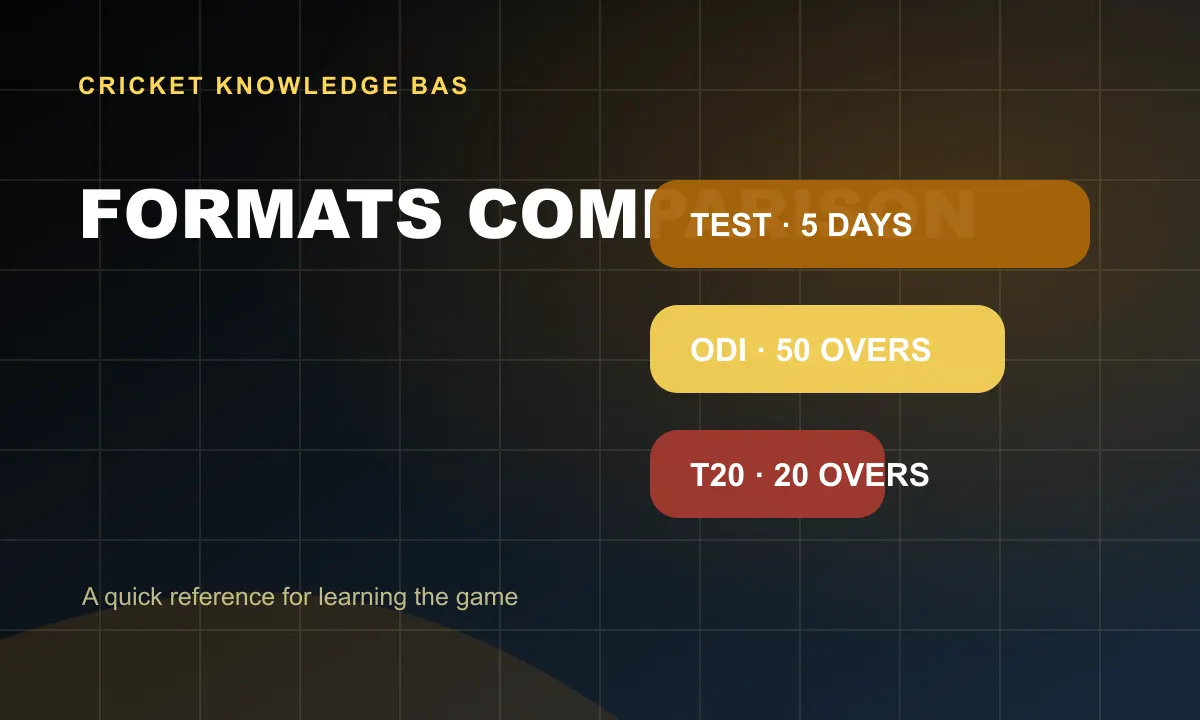
International cricket has three principal formats: Tests, One Day Internationals and Twenty20 Internationals. They share the same central laws but package time differently. Test cricket uses up to five days and two innings per side; ODI uses one 50-over innings; T20 uses one 20-over innings.
Quick reference
| Test | Up to five days, two innings per team |
|---|---|
| ODI | 50 overs per team |
| T20I | 20 overs per team |
| Longest tactical horizon | Test |
| Typical one-day format | ODI |
| Typical three-hour format | T20 |
Test cricket
Tests are the traditional international format. Each side normally has two innings, and the match can last up to five days. A winning side usually needs both a run advantage and enough time to dismiss the opposition twice.
The format rewards patience, durable technique, bowling spells and adaptation as the pitch and ball change. Draws are possible, which makes time management, declarations and survival part of strategy.
One Day Internationals
An ODI gives each side one innings of up to 50 overs. The format balances accumulation with controlled aggression. Batters can build long innings, while captains divide bowling resources across opening, middle and closing phases.
Fielding restrictions and bowler limits prevent purely defensive tactics. A full ODI fits within a day and provides enough time for recovery after early wickets without removing the urgency of an over cap.
Twenty20 Internationals
A T20I gives each side 20 overs. A match usually takes about three hours, and small sequences have a large effect. Boundary hitting, matchup planning, slower balls and athletic fielding are especially visible.
The format is not simply shortened ODI cricket. Teams value different skills and accept different levels of risk. One over can change the required rate dramatically, and a brief innings of 25 runs may be decisive.
Domestic and modified formats
Domestic cricket includes first-class, List A and T20 competitions that broadly correspond to long-form, 50-over and 20-over structures. Some competitions use further innovations in innings length, substitutions or presentation.
Junior, indoor, tape-ball and soft-ball cricket modify equipment, team size or pitch dimensions. These forms make the sport more accessible while preserving the core bowler-versus-batter contest.
How to learn this topic faster
Compare formats by resources rather than by stereotypes. Count balls, wickets, innings and available time, then ask how quickly those resources must be converted into runs. A choice that appears defensive in one format may be an intelligent response to conditions; a choice that looks exciting may leave too many unused risks later.
For Types of Cricket Matches, connect test cricket with one day internationals. The first idea gives you the structure; the second shows how players or institutions act inside it. Then return to the quick-reference facts and explain each one in your own words. If a fact cannot yet be explained, follow the linked guide rather than memorizing the label.
A useful learning routine is to predict the next event before it happens. In a rules article, predict the umpire’s sequence. In a format article, predict how the batting side will spend its remaining balls. In history, predict which institution or technology made the next stage possible. Prediction turns passive reading into a test of understanding.
Key checkpoints
- Test: Up to five days, two innings per team. Use this as a checkpoint when reading a scorecard, watching a match or explaining the topic to someone else.
- ODI: 50 overs per team. Use this as a checkpoint when reading a scorecard, watching a match or explaining the topic to someone else.
- T20I: 20 overs per team. Use this as a checkpoint when reading a scorecard, watching a match or explaining the topic to someone else.
- Longest tactical horizon: Test. Use this as a checkpoint when reading a scorecard, watching a match or explaining the topic to someone else.
- Typical one-day format: ODI. Use this as a checkpoint when reading a scorecard, watching a match or explaining the topic to someone else.
- Typical three-hour format: T20. Use this as a checkpoint when reading a scorecard, watching a match or explaining the topic to someone else.
Common misconceptions
Shorter does not mean easier, and longer does not mean inactive. T20 compresses choices and punishes small errors; Test cricket creates pressure through time, changing surfaces and repeated plans. ODI cricket is not merely the midpoint—it has its own 50-over resource pattern and tactical phases.
When two sources appear to disagree about types of cricket, check their date, match format and definition. One may describe an older playing condition, a domestic variation or a different category of competition. Prefer the current MCC Laws and the relevant official playing conditions for formal decisions, and label uncertainty clearly in historical questions.
A practical example
Frequently asked questions
What are the three international formats?
Test, ODI and T20I.
Which is the longest?
Test cricket, scheduled for up to five days.
Which is the shortest major international format?
T20I, with 20 overs per side.
Can a Test match be drawn?
Yes, when time expires without a completed winning result.
Do all formats use the same laws?
They share the Laws of Cricket, with format-specific playing conditions layered on top.
Conclusion
The three formats are best viewed as different time budgets for the same game. Tests reward sustained problem-solving, ODIs balance construction and acceleration, and T20 compresses decisions into a short event. Understanding that time budget explains most tactical differences.
Primary references
Rules and format details should always be checked against the current match or competition playing conditions.