Cricket becomes much easier when its vocabulary is organized into four groups: who is playing, what happens in one delivery, how the score grows and when an innings ends. You do not need to memorize every law. A small set of concepts explains nearly everything visible on the field and on a scorecard.
Quick reference
| Delivery | One ball bowled toward the striker |
|---|---|
| Over | Six valid deliveries |
| Innings | A team’s turn to bat |
| Boundary | Normally four or six runs |
| Wickets available | Ten in a standard completed innings |
| Score example | 142/6 means 142 runs for six wickets |
Runs and the score
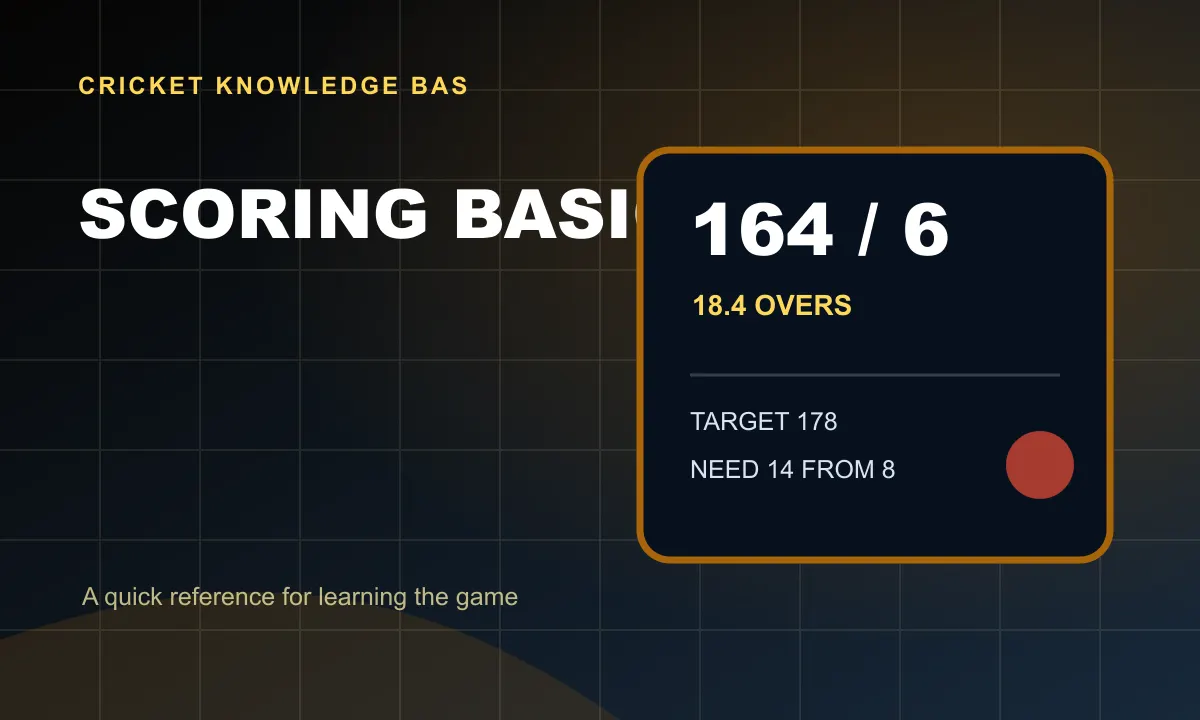
Batters score by exchanging ends while the ball is live. They may run once or several times, although most running produces one, two or three. Boundaries speed up the score: four runs when the ball reaches or crosses the boundary after touching the ground, and six when a ball hit by the bat clears it without first touching the ground.
Extras belong to the team rather than the batter. Common extras are wides, no-balls, byes and leg byes. A score shown as 142/6 means the batting team has 142 runs and has lost six wickets. In a chase, the required target is one more run than the opponent’s total.
Overs and innings
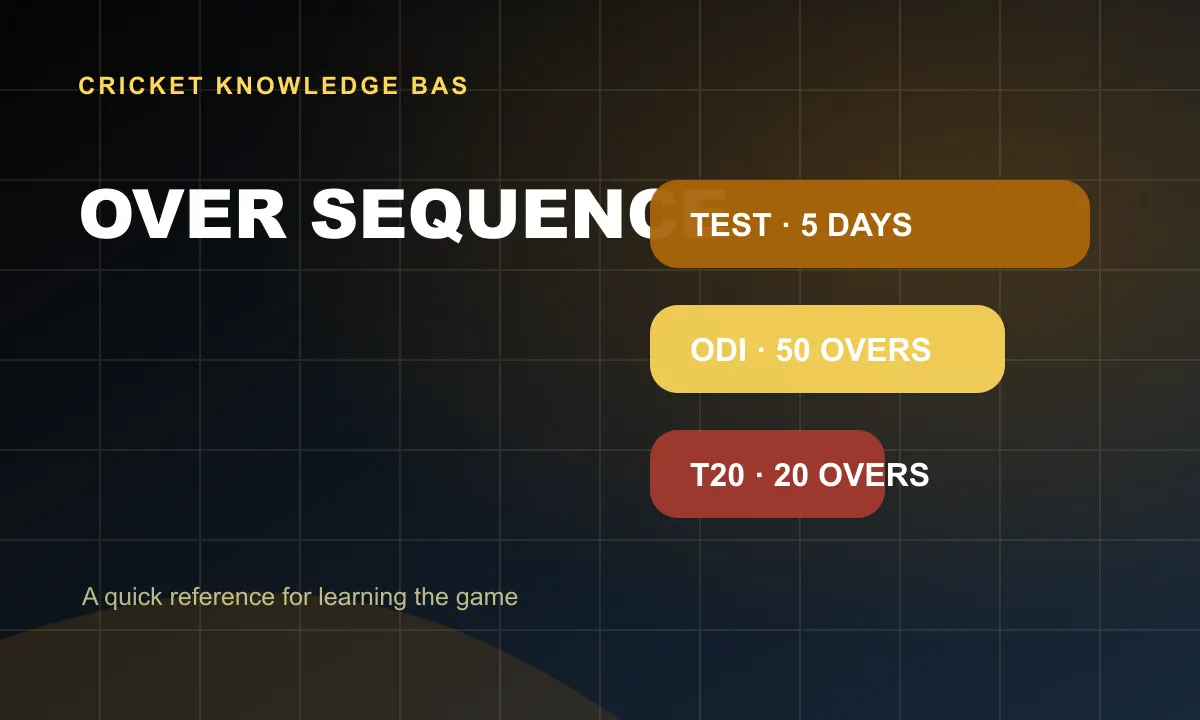
An over contains six valid balls delivered by the same bowler from one end. Wides and no-balls add runs but normally do not count among those six, so an over may contain more than six physical deliveries. At its completion, play switches direction and another bowler operates from the opposite end.
An innings is a team’s turn to bat. T20 and ODI cricket normally give each side one innings with a fixed over limit. Test cricket normally allows two innings per side and uses time rather than a fixed total-innings over allocation. An innings can also end when ten batters are out because two batters are needed to continue.
Wickets and dismissals
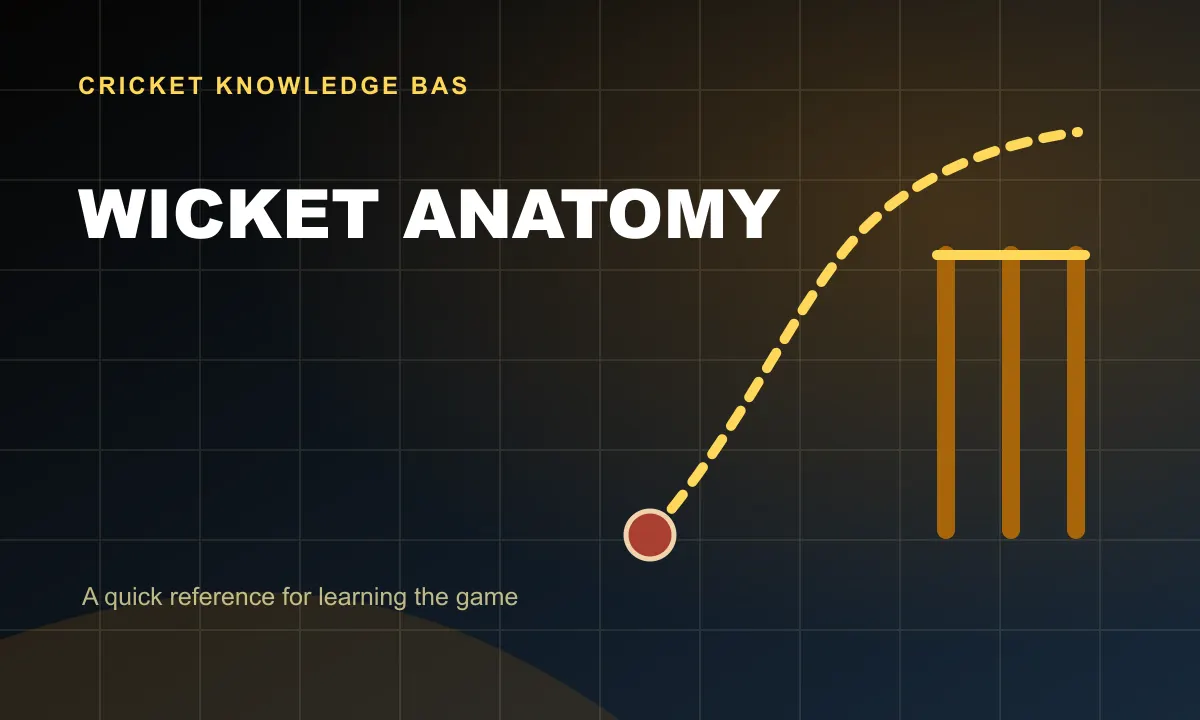
A wicket changes the batter at the crease and increases pressure on the batting side. The most familiar dismissals are bowled, caught, leg before wicket, run out and stumped. Less common methods exist, but these five cover the great majority of wickets a beginner will see.
The fielding side normally appeals by asking the umpire for a decision. Bowled dismissals are visually obvious, while LBW requires the umpire to judge where the ball pitched, where it struck the batter and whether it would have hit the wicket. Run-outs and stumpings depend on whether the batter has made good their ground.
Reading the match situation
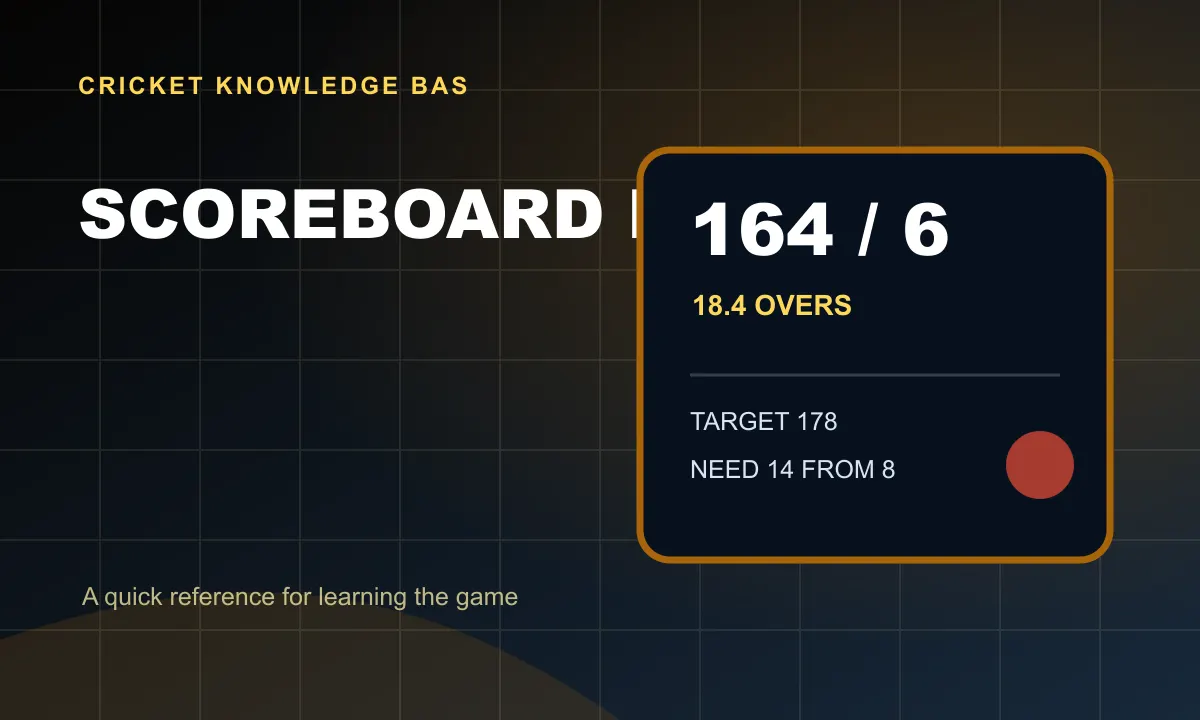
Look first at runs, wickets and overs. In a first innings, these numbers show how efficiently a team is using its resources. In a chase, add the target and balls remaining. Required run rate indicates how quickly the batting side must score; wickets remaining indicate how much risk it can afford.
Context gives the figures meaning. A score of 80/2 can be strong after ten overs of a T20, cautious after twenty overs of an ODI, or perfectly normal in a Test morning. The same shot may be sensible or reckless depending on format, target, pitch and match phase.
How to learn this topic faster
Watch one short passage of play and narrate only the visible sequence: delivery, contact, run or dot ball, and any wicket. This prevents unfamiliar commentary from hiding the simple contest. On a second viewing, add field position and intent. Layering observations in this order builds a reliable mental model without requiring a law-book memory test.
For Cricket Basics Explained, connect runs and the score with overs and innings. The first idea gives you the structure; the second shows how players or institutions act inside it. Then return to the quick-reference facts and explain each one in your own words. If a fact cannot yet be explained, follow the linked guide rather than memorizing the label.
A useful learning routine is to predict the next event before it happens. In a rules article, predict the umpire’s sequence. In a format article, predict how the batting side will spend its remaining balls. In history, predict which institution or technology made the next stage possible. Prediction turns passive reading into a test of understanding.
Key checkpoints
- Delivery: One ball bowled toward the striker. Use this as a checkpoint when reading a scorecard, watching a match or explaining the topic to someone else.
- Over: Six valid deliveries. Use this as a checkpoint when reading a scorecard, watching a match or explaining the topic to someone else.
- Innings: A team’s turn to bat. Use this as a checkpoint when reading a scorecard, watching a match or explaining the topic to someone else.
- Boundary: Normally four or six runs. Use this as a checkpoint when reading a scorecard, watching a match or explaining the topic to someone else.
- Wickets available: Ten in a standard completed innings. Use this as a checkpoint when reading a scorecard, watching a match or explaining the topic to someone else.
- Score example: 142/6 means 142 runs for six wickets. Use this as a checkpoint when reading a scorecard, watching a match or explaining the topic to someone else.
Common misconceptions
A common beginner mistake is to measure every action by excitement. A leave, defensive stroke or quiet over can be valuable when it protects a wicket or creates pressure. Another mistake is reading over notation as a decimal: 12.4 overs means 12 complete overs and four valid balls, not twelve and four-tenths.
When two sources appear to disagree about cricket basics, check their date, match format and definition. One may describe an older playing condition, a domestic variation or a different category of competition. Prefer the current MCC Laws and the relevant official playing conditions for formal decisions, and label uncertainty clearly in historical questions.
A practical example
Frequently asked questions
Why are there only ten wickets?
A team has 11 players but batting requires a pair, so the innings usually ends when ten are dismissed.
Does every over have exactly six balls?
It has six valid balls; wides and no-balls create extra deliveries.
What does a dot ball mean?
A delivery from which the batting side scores no run.
What is an innings?
One team’s completed or ongoing turn to bat.
Why do players change ends?
Batters change ends when they complete runs, and bowling changes ends after every over.
Conclusion
Follow cricket through its three resource columns: runs, balls and wickets. Once you can read a score such as 142/6 in 18.2 overs and understand what remains, the field settings and tactical choices begin to make sense. The laws add precision, but these basics provide the map.
Primary references
Rules and format details should always be checked against the current match or competition playing conditions.